FlowzByte
অষ্টম শ্রেণী ইংরেজি প্রথম অধ্যায় সহজ নোট কুইজ ও PDF ২০২৬
Are you an 8th-grade student looking for simple and clear notes for your English Chapter 1? You’ve come to the right place! This guide is designed to make learning easy, quick, and fun. Everything here is written in plain English, so you can understand it without confusion.
Ataul Gani Osmani Free AI Tools for Students অষ্টম শ্রেণী বিজ্ঞান শিক্ষার্থীদের জন্য ফ্রি AI টুল সপ্তবর্ণা
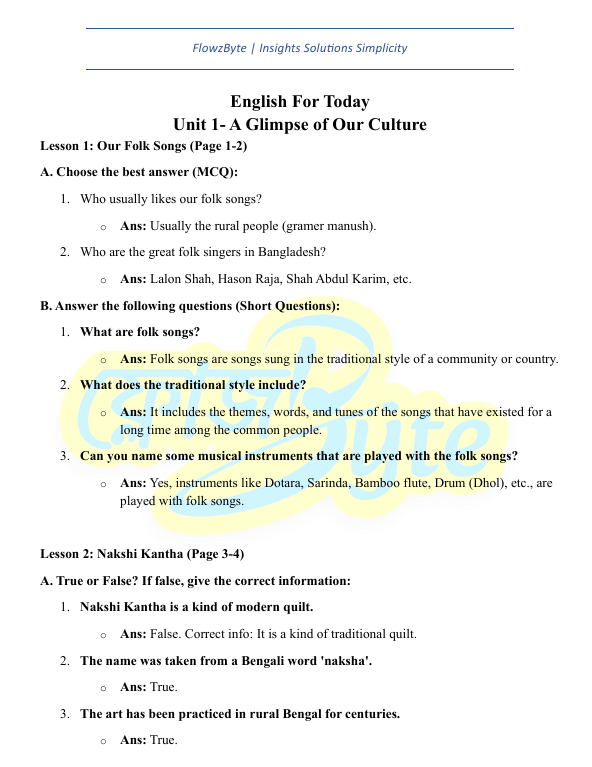
English For Today
Unit 1- A Glimpse of Our Culture
📄 Downloadable PDF 2026
Students can download the full Chapter 1 notes and exercises as a PDF for offline reading and revision. The PDF includes:
- Easy notes
- Key vocabulary
- Grammar rules
- Comprehension exercises
- Practice quizzes
নিজেকে যাচাই করো
Class 8 Unit 1: A Glimpse of Our Culture
Test your knowledge.
Question
Quiz Completed!
Lesson 1: Our Folk Songs (Page 1-2)
অষ্টম শ্রেণী গণিত প্রথম অধ্যায় সমাধান PDF ২০২৬
অষ্টম শ্রেণী বিজ্ঞান প্রথম অধ্যায় সহজ নোট কুইজ ও PDF ২০২৬
A. Choose the best answer (MCQ):
- Who usually likes our folk songs?
- Ans: Usually the rural people (gramer manush).
- Who are the great folk singers in Bangladesh?
- Ans: Lalon Shah, Hason Raja, Shah Abdul Karim, etc.
B. Answer the following questions (Short Questions):
- What are folk songs?
- Ans: Folk songs are songs sung in the traditional style of a community or country.
- What does the traditional style include?
- Ans: It includes the themes, words, and tunes of the songs that have existed for a long time among the common people.
- Can you name some musical instruments that are played with the folk songs?
- Ans: Yes, instruments like Dotara, Sarinda, Bamboo flute, Drum (Dhol), etc., are played with folk songs.
Lesson 2: Nakshi Kantha (Page 3-4)
A. True or False? If false, give the correct information:
- Nakshi Kantha is a kind of modern quilt.
- Ans: False. Correct info: It is a kind of traditional quilt.
- The name was taken from a Bengali word ‘naksha’.
- Ans: True.
- The art has been practiced in rural Bengal for centuries.
- Ans: True.
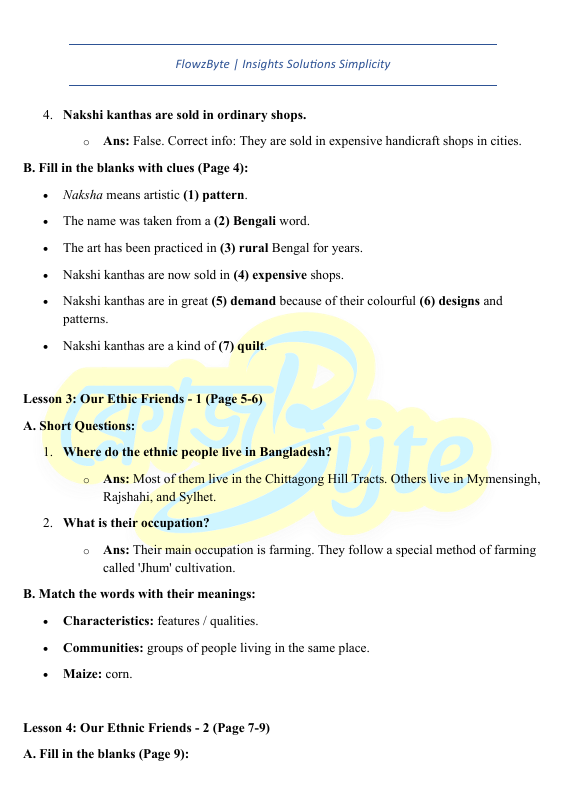
- Nakshi kanthas are sold in ordinary shops.
- Ans: False. Correct info: They are sold in expensive handicraft shops in cities.
B. Fill in the blanks with clues (Page 4):
- Naksha means artistic (1) pattern.
- The name was taken from a (2) Bengali word.
- The art has been practiced in (3) rural Bengal for years.
- Nakshi kanthas are now sold in (4) expensive shops.
- Nakshi kanthas are in great (5) demand because of their colourful (6) designs and patterns.
- Nakshi kanthas are a kind of (7) quilt.
Lesson 3: Our Ethic Friends – 1 (Page 5-6)
A. Short Questions:
- Where do the ethnic people live in Bangladesh?
- Ans: Most of them live in the Chittagong Hill Tracts. Others live in Mymensingh, Rajshahi, and Sylhet.
- What is their occupation?
- Ans: Their main occupation is farming. They follow a special method of farming called ‘Jhum’ cultivation.
B. Match the words with their meanings:
- Characteristics: features / qualities.
- Communities: groups of people living in the same place.
- Maize: corn.
Lesson 4: Our Ethnic Friends – 2 (Page 7-9)
A. Fill in the blanks (Page 9):
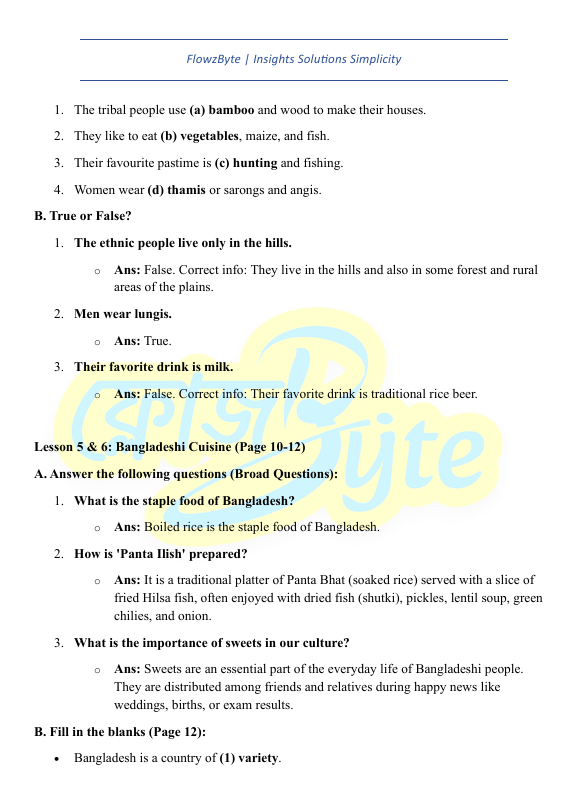
- The tribal people use (a) bamboo and wood to make their houses.
- They like to eat (b) vegetables, maize, and fish.
- Their favourite pastime is (c) hunting and fishing.
- Women wear (d) thamis or sarongs and angis.
B. True or False?
- The ethnic people live only in the hills.
- Ans: False. Correct info: They live in the hills and also in some forest and rural areas of the plains.
- Men wear lungis.
- Ans: True.
- Their favorite drink is milk.
- Ans: False. Correct info: Their favorite drink is traditional rice beer.
Lesson 5 & 6: Bangladeshi Cuisine (Page 10-12)
A. Answer the following questions (Broad Questions):
- What is the staple food of Bangladesh?
- Ans: Boiled rice is the staple food of Bangladesh.
- How is ‘Panta Ilish’ prepared?
- Ans: It is a traditional platter of Panta Bhat (soaked rice) served with a slice of fried Hilsa fish, often enjoyed with dried fish (shutki), pickles, lentil soup, green chilies, and onion.
- What is the importance of sweets in our culture?
- Ans: Sweets are an essential part of the everyday life of Bangladeshi people. They are distributed among friends and relatives during happy news like weddings, births, or exam results.
B. Fill in the blanks (Page 12):
- Bangladesh is a country of (1) variety.
- People here love (2) food.
- Our cuisine is rich with (3) spices.
- Rice, fish, and (4) lentils are common foods.
- During festivals, we prepare (5) Pitha.
More Questionary
Lesson 1: Folk Song
Q1: What are some examples of Bangladeshi folk music genres mentioned in the passage?
- Ans: Some examples of Bangladeshi folk music genres mentioned in the passage are Palligiti, Bhatiwali, Jari, Sari, Gambhira, Lalon Giti, Paalagan, and the songs of Hason Raja.
Q2: How are the instruments used in folk music connected to the land and environment?
- Ans: The instruments are crafted from materials found in the surroundings, such as animal skin, bamboo, and calabash. The sounds they produce are deeply connected to the land they come from.
Q3: What happens to folk music as people move to cities and villages change?
- Ans: As people migrate to cities and villages transform, these traditional tunes are slowly fading.
Q4: How is Bangladeshi folk music still present in mainstream media?
- Ans: Despite its decline, folk music still finds its place in mainstream films and music albums.
Lesson 1: The Life of Hason Raja (Rearranged Order)
Here is the correct chronological order of Hason Raja’s life according to the text :
- Dewan Hason Raja Chowdhury, simply known as Hason Raja, was a Bengali mystic poet and songwriter.
- He was born on 21st December 1854 in Teghoriya village of Lakshmansree Parghana, now Sunamganj, to a Bengali Muslim zamindar family.
- Despite his riches, he felt a deep connection with the common people.
- He established schools and religious centres like mosques and was widely engaged in charities.
- His unique style of music, filled with emotion and devotion, made him one of the most prominent figures in Bengali folk culture.
- Raja’s songs are collected in books named Hason Udas and Shaukhin Bahar.
- Hason Raja died on 6 December 1922.
- Today, a museum in Sylhet is dedicated to preserving his memory and contributions.
Lesson 2: Nakshi Kantha
Q1: What does the name ‘Nakshi Kantha’ mean?
- Ans: The name was taken from the Bangla word ‘naksha’, which means artistic pattern.
Q2: When did the name ‘Nakshi Kantha’ become popular?
- Ans: The name became popular after the poet Jasimuddin’s poem ‘Nakshi Kanthar Math’ was published in 1929.
Q3: Which districts are most famous for this craft?
- Ans: Mymensingh, Jamalpur, Rajshahi, Faridpur, Bogura, and Jashore are the most famous districts for this craft.
Q4: Why are Nakshi Kanthas in great demand now?
- Ans: They are in great demand because of the colourful patterns and designs embroidered on them, and they are now sold in many expensive handicraft shops in cities.
Lesson 3: Our Ethnic Friends – 1
Q1: Where do the ethnic people in Bangladesh live?
- Ans: Most of them live in the Chattogram Hill Tracts, while others live in the regions of Mymensingh, Rajshahi, and Sylhet.
Q2: What is ‘Jhum’ cultivation?
- Ans: It is a special method of farming where people clear a piece of land in the forest, prepare it, and sow seeds in it.
Lesson 5: Bangladeshi Cuisine
Q1: What is the staple food of Bangladesh?
- Ans: Boiled rice is the staple food of Bangladesh.
Q2: Why is fish so important in our diet?
- Ans: Since Bangladesh is a land of rivers, fish is a major source of protein and a very common dish. There is a popular saying, “Machhe-Bhate Bangali” (Fish and rice make a Bengali).
Q3: What is ‘Panta Ilish’?
- Ans: It is a traditional platter of Panta Bhat (soaked rice) served with a slice of fried Hilsa fish, often accompanied by dried fish, pickles, lentil soup, green chilies, and onion.
Which syllabus is this content based on?
This content is prepared according to the NCTB (National Curriculum and Textbook Board) Class 8 English syllabus for the 2026 academic year.
Is the language easy to understand for students?
Yes, all content is written in simple, clear English so that Class 8 students can understand easily.
Are these notes based on government-approved books?
Yes, the information is taken from NCTB government-approved textbooks and trusted educational sources.
Can students download the notes in PDF format?
Yes, students can download the full Chapter 1 notes and practice materials in PDF format for offline study
Is this content suitable for self-study?
Absolutely. This guide is perfect for self-study and daily revision at home.
Conclusion
In conclusion, 8th Grade English Chapter 1 is an important foundation for improving reading, writing, and grammar skills. With easy notes, simple explanations, practice quizzes, and a downloadable PDF, students can learn confidently without stress. Regular study and practice using these materials will help students understand English better, perform well in exams, and build strong language skills for the future. This guide is specially prepared to be clear, helpful, and student-friendly for the 2026 syllabus, making learning English easier and more enjoyable.
Table of Contents
📚 References
- NCTB (Government Book – Official): English for Today – Class 8
- NCTB English Grammar & Composition: Class 8 Grammar Book
- Class 8 English Book PDF: Govt Source Mirror PDF
- English Grammar (General Reference): Wikipedia – English Grammar

Md Rabiul Hosen Sejan